
The electrification of marine watercraft can often take advantage of mature technologies developed for road vehicles, but in some cases, adaptation is needed for the marine environment. In an SEC pre-study, researchers explore how standard EV charging systems can be used for boats without causing unwanted electrical paths.
“The electrification of boats has not come as far as road vehicles, but there are a lot of mature technologies from road vehicles that can be adapted to a marine environment. Charging technology is a good example of that,” says Nicholas Honeth, researcher at KTH, who has led the SEC pre-study “Marine charging systems for light watercraft”.
Unwanted electrical paths
Light watercraft, with power requirements similar to electric cars, can largely reuse the same charging technology. However, there are challenges related to boats being surrounded by water, which can cause unwanted electrical paths between the vessel and docking station. This is not a problem with electric cars since they are isolated by their tyres.
Nicholas Honeth explains the problem: “For safety reasons, a protective earth must be used, and in boats it’s connected to the hull. This means that once connected to shore power, the hull, dock structures and seawater can form a galvanic circuit. The water acts as the electrolyte in an electrochemical cell, and the metal in the boat, in the worst case a propeller or parts of the aluminium hull, can act as the anode and begin to corrode.”
This problem is not new and there are technical solutions like galvanic isolation, double-insulated direct current chargers. However, these solutions can be both expensive and impractical, and are not necessarily compatible with standard EV charging systems used for road vehicles.
A three-way problem
“It’s a three-way problem that needs to be solved. We want to preserve the signalling required by the EV charging system while satisfying safety standards, and keeping the watercraft protected from corrosion. Generally only two of these can be fulfilled at once,” Nicholas continues.
To investigate possible solutions a small-scale experiment replicating realistic shore-to-boat charging installations was set up, measuring galvanic currents with and without isolation devices.
“We have identified the main barriers to reusing EV charging technology in boats and have pointed to promising technical solutions validated in simulations. The next step would be to prove that the concept works in real-world marine environments,” Nicholas explains.
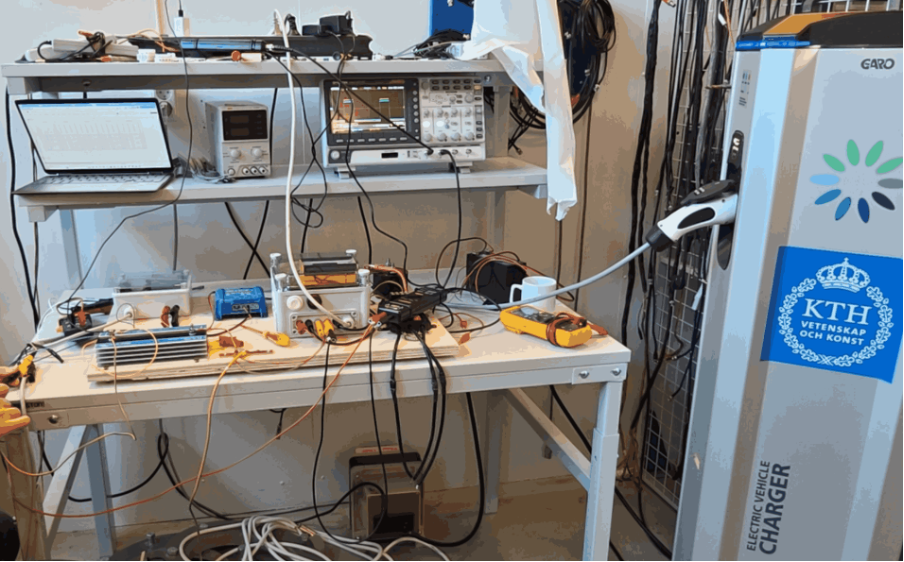
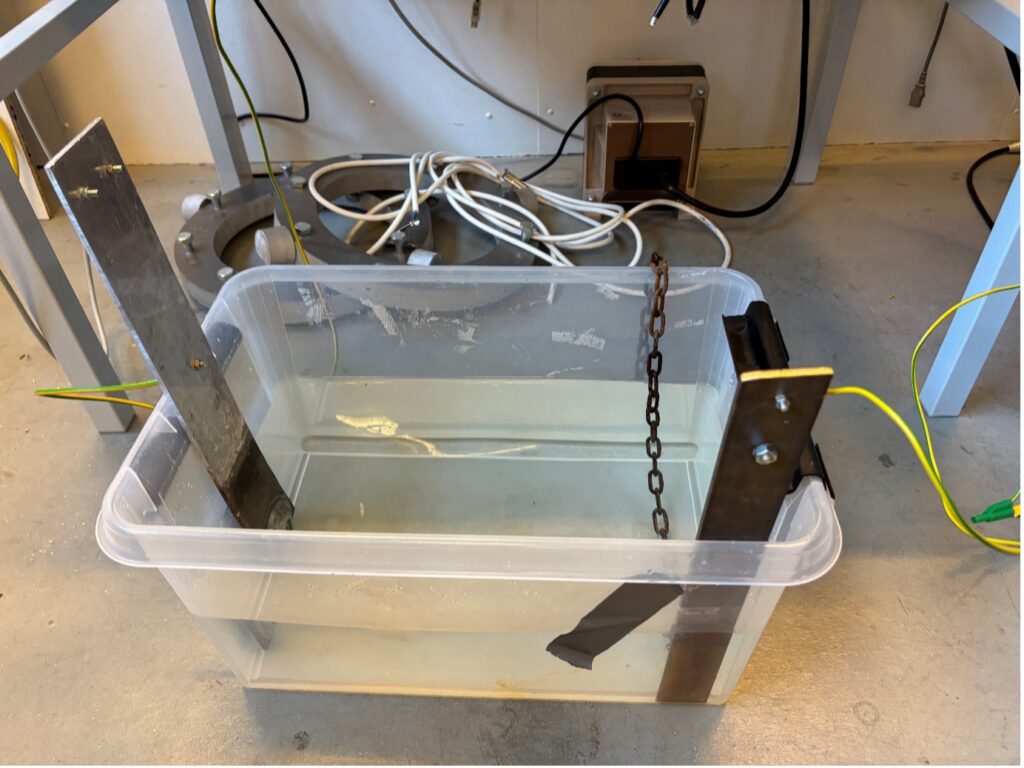
The setup included an actual charging post, charging communication hardware, a propulsion system, auxiliary systems and a model of a boat hull connected through water to a representation of shore infrastructure.
The study also identified some previously undocumented safety concerns.
“We discovered that under certain circumstances a person bridging a path between an earthed dock structure and the hull could complete part of the charging circuit and allow charging to initiate when the system should actually be in an error state. Under specific fault conditions, that could contribute to a dangerous electrical situation”, says Nicholas.
When talking about the future of electric boats Nicholas feels optimistic.
“Yes, I definitely think electric boats are coming. There is growing public interest and there are many positives like reduced noise and maintenance requirements. Of course, there are still improvements to be made, especially for faster boats when it comes to range. But with improved battery chemistries, hydrofoils and vehicle-to-grid solutions the business cases for boats become more and more compelling. Especially for sailboats and other slower vessels where electric propulsion is already a very attractive alternative,” he concludes.
About Nicholas Honeth and the project
Nicholas Honeth is from South Africa and moved to Gothenburg to do his master’s degree at Chalmers University of Technology. He then pursued his PhD at KTH – The Royal Institute of Technology in Stockholm, where he now works as a researcher at the Department of ElectricPower and Energy Systems. Nicholas has led the the project together with Mats Leksell, also from KTH. Volvo Penta has contributed with funding and active participation.