
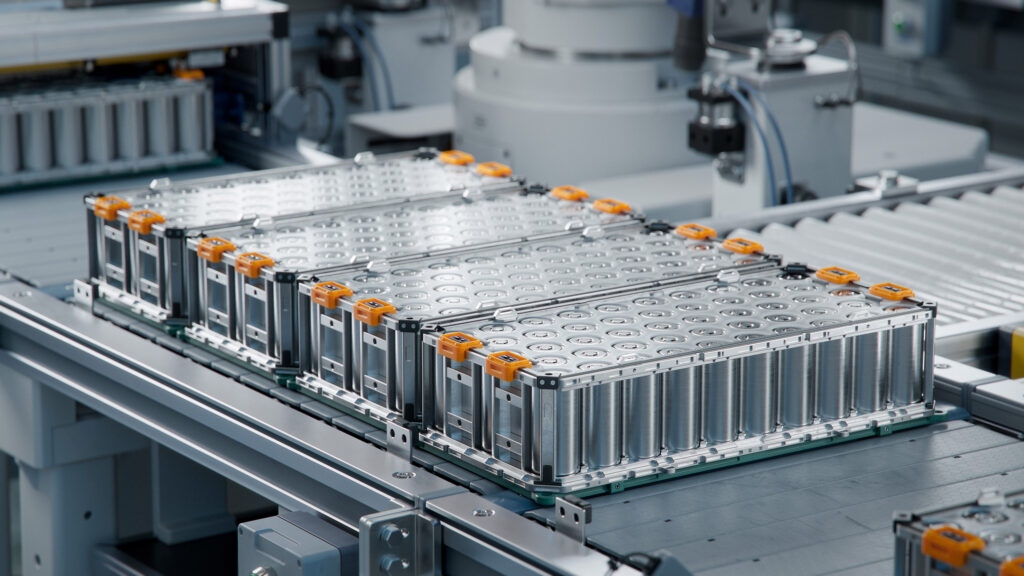
Gases are to various extents always generated in batteries, particularly during the initial formation cycles. This is seldom causing problems in new batteries, but with age the gas evolution increases which can influence the battery negatively. Gas evolution has been studied extensively in small laboratory cells, however comparatively little work has focused on commercial battery cells of the type used in electric vehicles.
If there are high gas releases in batteries as they age the cells can get swollen and have a high internal pressure. “Many people have seen an old phone or laptop battery start to swell, and that is often caused by gas formation, explains Amritha Pushkaran Sandra, who is a PhD student at KTH involved in the SEC project “Gas evolution in commercialy available batteries”.

Gas evolution can cause problems but modern battery packs have advanced battery management systems with safety mechanisms. “If a cell begins to behave abnormally, for example by becoming too warm, the battery management system can limit operation and help prevent a hazardous situation,” Amritha reassures.
“Hower, we want to understand how gas evolution changes with ageing and how it relates to the battery’s condition. This knowledge is important to keep improving performance and using batteries safely for longer periods,” says Amritha.
This project is investigating gas evolution in lithium-ion batteries from cylindrical 21700 cells harvested from a used Tesla Model 3 battery pack. The cells have been used in a number of ageing studies and therefore represent a resource with well-documented usage histories. However, the gas evolution has not been studied and one goal in the project has therefore been to understand how gas formation relates to degradation in cells with different histories and states of health.
Extracting gases is easier said than done
Before the gases can be measured, they must first be extracted. A significant part of the project has therefore been devoted to developing and refining a specialised experimental setup capable of analysing gases from these larger cylindrical cells in real -time.
“In principle, you puncture the cell and transferred into a specially designed sealed container. The container can connected to the gas measurement instrument (mass pec) and potentiostat and measure the gas evolved during cycling in real-time. It may sound simple, but developing a reliable system for cylindrical cells is very difficult,” Amritha explains.
The work with the experimental setup builds on previous research from KTH, but the system has been further developed to enable measurements of gas composition, temperature and pressure simultaneously.
“I would say that the work with the setup is an important part of the project in itself. We now have an online electrochemical mass spectrometry system with a continuous flow of argon and a cell housing that can be adjusted for formats ranging from small laboratory cells to cylindrical commercial cells. This gives us a way to study many market-relevant cells and chemistries. Relatively few research groups have quantified gas evolution in aged commercial cells, so there is still a great deal to investigate”, says Amritha.
Rather than looking for solutions at this stage, the project has focused on measuring, quantifying and understanding gas evolution, which is the first step towards understanding the safety limits of batteries. The gases have been monitored in real time during charging and discharing, and quantified from cells with different states of health and different histories.
“The initial findings suggest that battery state of health (SOH) cannot be understood through capacity measurements alone, since cells with similar remaining capacity do not necessarily behave in the same way. Temperature, charging rates and operating conditions can all influence how much gas is produced. However, more analysis is needed before we can explain all the differences,” says Amritha.
The research has revealed that battery ageing is more complex than expected. In several cases, cells that appeared heavily degraded behaved surprisingly well, producing gas signatures similar to batteries much earlier in their life cycle.
Battery ageing is complex
“What’s interesting to see is that sometimes the result does not necessarily match the original hypothesis. In some cells with around 50 per cent remaining capacity, we expected little gas because we thought the electrolyte might be largely dried out. Instead, some of those cells behaved unexpectedly well and produced results comparable with cells closer to the beginning of life. We then must go back to the cell history and ask why,” says Amritha.
Another motivation for building knowledge about gas evolution is the growing interest in extending battery life beyond the first application. When a battery pack no longer meets automotive performance requirements, many of its cells may still be suitable for stationary energy storage systems.
“Understanding gas evolution could help in assessing whether such batteries can be safely reused, and the next step is post-mortem analysis. The cells will be opened so that we can study the electrodes, electrolyte salts and other material-related changes. We will then combine the gas data with the chemistry and electrochemistry of the differently aged cells,” Amritha concludes.
Important knowledge for second life applications
Another motivation for building knowledge about gas evolution is the growing interest in extending battery life beyond the first application. When a battery pack no longer meets automotive performance requirements, many of its cells may still be suitable for stationary energy storage systems.
“Understanding gas evolution could help in assessing whether such batteries can be safely reused, and the next step is post-mortem analysis. The cells will be opened so that we can study the electrodes, electrolyte salts and other material-related changes. We will then combine the gas data with the chemistry and electrochemistry of the differently aged cells,” Amritha concludes.
About
Amritha Pushkaran Sandra has a background in chemistry and completed both her bachelor’s and master’s degrees in India before moving to Sweden to begin her PhD at KTH in 2022. The project “Gas evolution in commercialy available batteries” is an important part of her PhD thesis. The project is carried out in collaboration with Traton, contributing to battery cell tear-down and post-mortem analysis, and Volvo Cars, contributing with modelling and CT scans.